




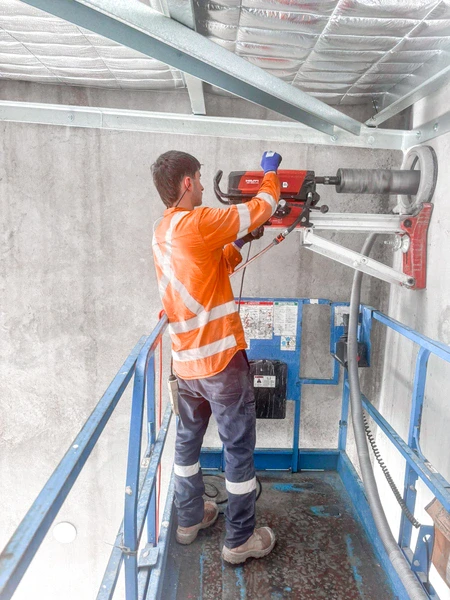
A service penetration can look pretty simple on a construction drawing.
A circle through a slab. A mark on a wall. A diameter and a location.
On site, there’s usually a little more going on.
That circle could sit directly above reinforcement, a post-tension cable, an electrical conduit or another service hidden inside the concrete. And on the other side, there’s normally another trade relying on that opening being exactly what they need.
That’s why at Slice It Right, drilling service penetrations starts with understanding what we’re drilling into and what the opening actually needs to achieve.
From our experience, many of the decisions that determine whether a penetration works well happen before the drill starts.
First, What’s Behind the Concrete?
Concrete doesn’t give much away from the surface.
A 100 mm penetration might seem insignificant on a large commercial project, but there can be a lot packed into those 100 mm.
Reinforcement, post-tension cables, electrical conduits and hydraulic services can all influence where and how an opening is created. Depending on the structure, concrete scanning may be used to identify what’s below the surface. Structural drawings, engineering information and existing service plans can also help build a clearer picture.
The idea is simple: remove as many unknowns as possible before removing concrete.
We’ve worked on enough existing structures to know that what looks straightforward from the outside isn’t always straightforward once you understand what’s inside.
That’s why we want to know as much as possible before the core drill comes out. It protects the structure and can prevent a relatively small drilling job from becoming a much larger and more expensive issue for the project.
For something as small as a service penetration, there can be a lot riding on getting it right.
Every Penetration Has a Job to Do
We rarely drill a hole just because someone needs a hole.
There’s normally a service waiting for it.
It might be plumbing through a slab, electrical conduits through a wall, fire services reaching another area, data and communications finding a route through the building, or mechanical and HVAC services travelling between floors.
Understanding that purpose helps us understand the opening.
Where does the service need to finish? What diameter does it need? Does it need to line up with pipework or equipment on another level? Is there enough clearance for the trade to install what needs to pass through it?
At Slice It Right, we don’t look at our core drilling as an isolated task.
We don’t measure a successful penetration by the moment the core comes out. We measure it by what that opening allows to happen afterwards.
Before Drilling Service Penetrations, Ask These Questions
Before setting up, we want a good understanding of both sides of the concrete.
What’s inside it? What’s underneath it? Can we access the other side? Is concrete scanning required? What diameter and depth are needed? Is the building occupied? Are there finished surfaces nearby? How will water and slurry be managed?
These aren’t questions we ask to make a simple job complicated.
They’re how we keep a simple job simple.
A vertical core through an open slab is one situation. On the next job, we might be setting up underneath a finished ceiling or drilling horizontally through a reinforced concrete wall where the exit position matters just as much as where we start.
Same basic objective. Completely different setup.
By the time we start drilling, we want as many of those questions answered as possible.
Not Every Core Is Straight Down Through a Slab
This is where having the right drilling capability makes a difference.
At Slice It Right, our concrete drilling services go well beyond standard vertical penetrations.
We drill horizontally through reinforced concrete walls and inverted from underneath slabs when there’s no practical access from above. We can complete larger-diameter and deeper cores, work in restricted-access areas and use stitch drilling where a larger opening can’t practically be achieved with a single core.
Sometimes there’s plenty of room to set up. Other times, we’re underneath a slab, against a wall, above a finished area or positioning a rig around existing services.
That’s why we’ve invested in specialist core drilling equipment and different rig setups. Having options allows us to adapt our approach to the structure rather than trying to make every job fit the same method.
For anyone searching how to drill through concrete, there isn’t one professional answer.
The right approach depends on the structure, reinforcement, access, drilling direction, depth, diameter and surrounding environment.
Controlled wet core drilling can help manage the drilling process and vibration, while water and slurry need to be properly contained and collected. Finished or occupied environments require additional protection, and through thicker walls, floors or ceilings, where the core exits can be just as important as where it starts.
The equipment gives us options. Experience tells us which option makes sense.
One Opening Can Affect Several Trades
Concrete core drilling in Perth rarely happens in isolation, particularly on commercial projects.
The builder may be coordinating the programme. The engineer has requirements around the structure. Hydraulic, electrical, fire and mechanical contractors can all have services competing for space.
We’ve seen how a penetration that works perfectly for one service can interfere with another. Multiple openings may also need to work around reinforcement and existing services while leaving enough room for each trade to complete its installation.
That’s where communication before drilling makes a real difference.
The earlier those requirements are understood, the easier it is to identify potential clashes before concrete has been drilled or completed work needs to be changed.
For us, the core hole might be our scope.
But the opening becomes part of the whole project.
The Best Core Holes Don’t Create Another Job
Some of our best core drilling work is probably the work nobody talks about once we leave.
The penetration is where it should be. The diameter is right. The surrounding concrete and finishes have been looked after. Water and slurry have been managed.
Then the plumber, electrician or mechanical contractor arrives, installs their service and gets on with their work.
No additional cutting. No opening that needs enlarging. No unnecessary modification to make something fit.
It just works.
And while that sounds simple, achieving it comes back to understanding the structure, communicating with other trades, choosing the right setup and drilling accurately.
An opening, not another problem to solve.
When the Core Drilling Gets Difficult, Capability Matters
One thing we’ve learned is that the penetration shown on the drawing rarely tells the whole story.
We’ve drilled vertically through slabs, horizontally through reinforced walls and inverted from underneath when there was simply no access from above. We work with standard service penetrations, large-diameter cores, deeper concrete sections, restricted-access environments and stitch drilling where one core isn’t enough.
Then there are jobs where drilling is only half the challenge: protecting finished areas, managing water and slurry, getting equipment into difficult positions, working around existing services and coordinating with other trades.
Those jobs have shaped how we approach drilling service penetrations today.
We continue investing in specialist equipment because we want our Slicers to have options when a project isn’t straightforward. But equipment alone isn’t the answer. Knowing how to set it up, when to use it and what’s happening around the opening is just as important.
That’s the standard we want Slice It Right to be known for as a core drilling company in Perth — understanding the structure, asking the right questions and finding a practical way to create the opening the project actually needs.
Got a Penetration That Isn’t Quite Straightforward?
Send us the drawings, give us a call or get the Slicers involved before drilling starts.
Whether you need standard service penetrations, commercial core drilling in Perth, large-diameter cores, horizontal or inverted drilling, concrete scanning or a solution for a difficult-access opening, we can look at the structure, access and requirements and work out the right approach with you.
We work with builders, engineers, project managers and service contractors across Perth and regional WA.
If it needs to go through concrete, talk to the Slicers. We’ll Slice It Right.
Making openings. Removing obstacles. Creating opportunities.