




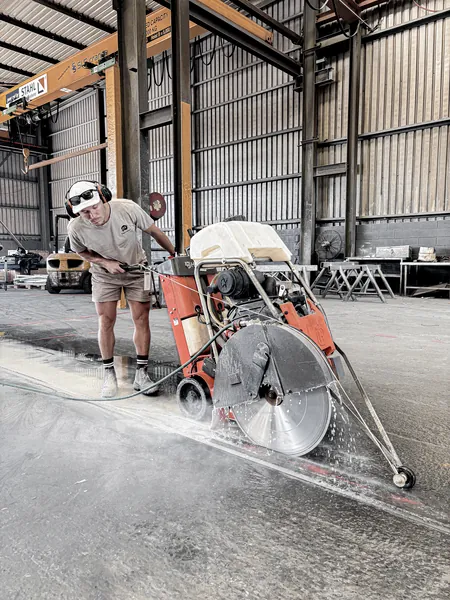
There are plenty of ways to cut concrete. Knowing which one to use is very important. Different projects call for different concrete cutting methods, and the decision comes down to more than just concrete thickness.
At Slice It Right, we cut concrete across residential, commercial, civil and infrastructure projects throughout Perth and regional WA. One day it might be a doorway through a reinforced wall, the next a trench through a commercial slab for new drainage or precise cuts as part of a structural modification.
These are the questions we ask before choosing how we’re going to cut.
What’s behind it? What’s underneath it? Is it reinforced or post-tensioned? What needs to remain untouched? How will the cut section be removed? And what does the next trade need from us when we’re finished?
Getting the method right from the beginning means a cleaner job, fewer surprises on site and an easier handover to the trade following us.
Why We Use Different Concrete Cutting Methods
If one saw could do everything, our job would be considerably easier.
But concrete doesn’t tend to cooperate like that.
A 100mm residential slab isn’t the same proposition as a heavily reinforced commercial wall. A trench through an open warehouse floor gives us options that a structural opening inside an occupied building doesn’t. And cutting beside an existing finished surface requires a different approach again.
Choosing between hand sawing, ring sawing, flush cutting, wall sawing and floor sawing comes down to what we’re cutting, where we’re cutting it and what needs to happen next.
Hand Sawing: Flexibility Where Bigger Equipment Can’t Go
Some projects simply don’t give us much room to work with.
Tight access, smaller openings and existing structures can make larger equipment impractical. Hand sawing gives us the flexibility to make accurate cuts without bringing more equipment into the area than the job needs.
We might use it for a smaller opening through a wall for new services, cutting around an existing slab before demolition or modifying a footing.
It’s also regularly used alongside other cutting methods to complete sections larger equipment can’t reach.
The machine doesn’t need to be the biggest one on site. It needs to be the right one for the cut.
Ring Sawing: When We Need More Depth
Sometimes we need the flexibility of a handheld saw, but more cutting depth than a standard blade can provide.
That’s where ring sawing comes in.
We may use a ring saw for a deeper wall opening, a thickened section of slab or to continue a hand-sawn opening where additional depth is required.
It’s not about reaching for another saw because the first one didn’t work. An experienced operator should understand the depth and structure before cutting begins and plan the right combination of equipment from the start.
Flush Cutting: When What Stays Matters as Much as What Goes
There are plenty of jobs where removing the concrete is only half the brief.
The wall, slab, footing or finished surface beside it still needs to be there when we’re finished.
Flush cutting allows us to cut close against an adjoining surface where a standard setup would leave concrete behind. A good example is removing a slab or footing hard against an existing wall while leaving the remaining surface as clean as possible for the next stage.
What we leave behind matters.
Wall Sawing: Creating Openings That Change Buildings
New doorways. Larger windows. Lift access. Structural openings. New services.
Wall sawing is where concrete cutting can physically change how a building works.
Track-mounted wall saws give us the accuracy and control needed to create larger openings through reinforced concrete.
But before the saw goes on the wall, we need to understand what that opening is becoming.
Where does the structural steel need to sit? What finish does the builder need? How will the concrete be supported and removed? What’s happening on the other side?
We’re creating more than a hole in a wall. We’re creating the access point, doorway or service route needed for the next stage of the building.
Floor and Road Sawing: Making Way for What Needs to Go Below
A lot of our floor sawing work starts with another trade needing to get underneath an existing slab.
A plumber needs a trench for drainage. Electrical services need a new route. A commercial slab needs modification. Infrastructure needs to go beneath an existing roadway.
Floor and road sawing creates controlled cuts through horizontal concrete and asphalt so the section between them can be removed.
If we’re cutting a long trench for a plumber, for example, we’ll often cross-cut the slab into manageable sections so it can be removed efficiently and the plumber can get in and start laying pipework.
Concrete thickness, reinforcement, removal methodology, slurry management, access and existing services all form part of planning those cuts.
A good cut should make the next trade’s job easier, not leave them with another problem to solve.
The Concrete Usually Isn’t the Problem. It’s Everything Around It.
Concrete is predictable.
What has been put inside it, underneath it and around it isn’t always.
Inside a slab or wall we can encounter reinforcement, post-tension cables and embedded services. Underneath might be plumbing, electrical infrastructure or a finished ceiling that absolutely cannot become part of the demolition.
Around us could be operating machinery, finished surfaces, members of the public or other trades trying to complete their own work.
Add restricted access, water and slurry management, structural considerations and construction programmes, and suddenly the concrete itself is the straightforward part.
At Slice It Right, some of the most important work happens before the blade starts turning: asking questions, checking plans, scanning where required and understanding how our work fits into the wider project.
Anyone can look at a line and think about the cut.
The best concrete cutters think about everything around it.
Concrete Cutting and Coring Usually Belong in the Same Conversation
Concrete cutting and coring often solve different parts of the same problem.
A commercial refurbishment might need a doorway cut through a wall, core holes through the slab for hydraulic services and a trench across the floor for drainage.
That’s wall sawing, concrete coring and floor sawing but to the builder, it’s one stage that needs to be completed before everyone else can move forward.
Planning concrete cutting and coring together means access, scanning, sequencing and water management can be considered as one scope rather than discovering each requirement separately.
Our work often happens before plumbing, electrical, mechanical, structural steel and fit-out can continue.
We call ourselves the trades before the trades for a reason.
Safe Concrete Cutting Starts With Questions
Safe concrete cutting in Perth and across WA doesn’t begin when someone starts a machine.
It starts with knowing what we’re cutting into.
Do we need concrete scanning? Are there known services? Is the structure post-tensioned? Can water be used here? Where is the slurry going? What’s directly below us? How will the concrete be supported and removed?
Sometimes one answer completely changes the cutting method.
Planning properly protects the people on site, the structure and the programme. Finding an unexpected service halfway through a cut isn’t just a concrete cutting problem. It can quickly become everyone else’s problem too.
A Good Cut Should Move the Project Forward
For us, concrete cutting isn’t really about concrete.
It’s about what the concrete is currently stopping someone from doing.
A wall is stopping a new doorway. A slab is stopping a plumber reaching the ground below. A suspended slab needs penetrations before new services can be installed.
Our job is to remove that obstacle in the safest, cleanest and most practical way we can.
That’s why there isn’t one “best” concrete cutting method. There is the method that makes sense for that structure, that site and that stage of the project.
And knowing the difference comes from experience.
At Slice It Right, we assess every project individually, work through the risks and choose the concrete cutting method around the outcome the project actually needs.
Making openings. Removing obstacles. Creating opportunities.
Got Concrete in the Way? Let’s Talk.
If concrete is standing between where your project is and what needs to happen next, get us involved early.
Send us the plans, photos or scope. We’ll look at what you’re trying to achieve, talk through the best approach and get the cutting organised.
Concrete cutting, coring or structural modifications across Perth and regional WA. Contact Slice It Right and let’s get your project moving.